
Guy Debord: We Have Been Reduced to Spectators in a Society of Endless Spectacle
In his prescient 1967 work The Society of the Spectacle, Guy Debord argues that modern consumer society increasingly replaces lived experience with its representation. Rather than actively engaging in reality, we are becoming passive spectators of endless spectacle.


Surrounded by spectacle, via Unsplash
In the modern industrialized world, life “presents itself as an immense accumulation of spectacles. All that once was directly lived has become mere representation.”
So declares the French philosopher Guy Debord in his utterly prescient 1967 work, The Society of the Spectacle, which argues that consumer society replaces authentic social life with the passive consumption of images.
More and more of the world comes to us indirectly, through packaged fragments designed to be consumed. Even when these fragments are totally accurate, they supplant active participation, turning lived events into things we primarily encounter as representations.
Thus social life has become mediated, Debord declares: like consumers choosing between commodities, we have become spectators choosing between spectacles.
The relevance of this analysis to today’s internet-driven mass media hardly needs pointing out. The latest celebrity hysteria, the breaking news catastrophe, the geopolitical crisis: all are delivered to our screens via carefully curated parcels designed to engage, enrage, and titillate.
So enticing are these parcels that what’s on our screens can at times feel more urgent and real than reality itself. The world around us devolves into an irrelevant kind of staging area, useful only for the construction of more spectacle.
Such detachment from reality indicates a more general shift in the human experience, Debord argues. While early stages of capitalism switched the emphasis of human life from “being” to “having”, Debord claims later stages of capitalism encourage us to slide even deeper into unreality: from “having” to “appearing”.
An earlier stage in the economy’s domination of social life entailed an obvious downgrading of being into having that left its stamp on all human endeavor. The present stage, in which social life is completely taken over by the accumulated products of the economy, entails a generalized shift from having to appearing: all effective “having” must now derive both its immediate prestige and its ultimate raison d’etre from appearances.
Appearance has become a substitute for reality, and visibility is this new world’s currency. Brand building is not just for media or business; it’s in our politics, our popular conceptions of fame and identity, and even in our social and personal lives. What’s the size of your audience? How much clout do you have?
The logic insisted upon by the spectacle, Debord suggests, is that
Everything that appears is good; whatever is good will appear.
The greater the visibility, the greater the value. The share of the market, the share of success, is now governed by the share of attention.
So what is the purpose of all this spectacle? What does it do to society? What does it do to us?
Importantly, Debord does not see “spectacle” merely as a synonym for the mass media we produce and consume. Yes, the production of spectacle is often biased and inauthentic. Yes, we can be concerned with projecting the appearance of status and value to others within our own information bubbles. But all these bubbles ultimately float in a single sea, and that sea is capitalism.
Debord’s core thesis is that spectacle, be it constructed or consumed, is the ultimate reinforcer of capitalistic values. As he puts it:
The spectacle is not a collection of images, but a social relation among people, mediated by images.
Spectacle governs the reality of the worker outside of work hours, and its goal is to keep the worker entranced, inactive, and receptive to the imperatives of perpetual production and consumption.
Through ceaseless spectacle, capitalism conducts an “opium war” that reduces potentially active citizens into passive, pliable spectators: overwhelmed into inertia by the sheer scale of things that are happening, alienated from their own desires, and needful of new things to fill the void. As Debord puts it:
The spectacle’s function in society is the concrete manufacture of alienation.
The spectator’s alienation from themselves, and accompanying submission to the dominant system, proceed as follows:
the more he contemplates, the less he lives; the more readily he recognizes his own needs in the images of need proposed by the dominant system, the less he understands his own existence and his own desires [...] the individual’s own gestures are no longer his own, but rather those of someone else who represents them to him. The spectator feels at home nowhere, for the spectacle is everywhere.
Commentaries, critiques, and ‘hot takes’ about the world themselves become aspects of spectacle, a ‘marketplace’ where narratives can be bought, sold, and spun to populate, sustain, and ultimately pacify the worker’s nonworking hours.
Even slogans urging us to disconnect, even this article itself, all are messengers of capital. As Debord writes:
In all its specific manifestations – news or propaganda, advertising or the actual consumption of entertainment – the spectacle epitomizes the prevailing model of social life. It is the omnipresent celebration of a choice already made in the sphere of production, and the consummate result of that choice. In form as in content the spectacle serves as total justification for the conditions and aims of the existing system. It further ensures the permanent presence of that justification, for it governs almost all time spent outside the production process itself.
When we’re not actively working, when we’re not actively producing for the economy, we’re passively consuming the spectacle that sustains it.
Spectacle is the social glue that binds the infrastructure of late-stage capitalism: it’s the means by which consumerism and the broader economy come to infiltrate and eventually totally dominate every sphere of human life.
Is spectacle really a unified tool of capitalism?
Perhaps Debord’s analysis seems a bit strong. Is everything we witness (this so-called ‘spectacle’) really a unified tool of capitalism? If so, who’s running the show? Within the vast diversity of human civilization, aren’t there radically competing narratives, groups, and powers vying for our attention and support – some of which actually oppose the dominant ideas of the establishment and the values they express?
Debord isn’t saying the spectacle is run by a shadowy cabal of ultra evil capitalists, but that it’s the structural, inevitable, emergent outcome of a world driven by capital accumulation. The spectacle is an expression of commodity society, and reproduces the social relations of capitalism.
And Debord’s critique was not directed solely at Western consumer capitalism, which he dubbed the “diffuse spectacle”; he also analyzed Soviet-style bureaucratic societies as another form of capitalist domination, which he called the “concentrated spectacle.”
His point is that while there are genuine struggles within and between peoples and nations, all these struggles occur within a capitalist socioeconomic superstructure that has already conquered the human world.
War, catastrophe, revolutions: these simply become another form of spectacle, happening elsewhere, for us to consume on our way to work.
Though the spectacle of conflict plays out daily on our devices, Debord points out that we must never forget that the institutions in conflict
have been established for the purpose of running the same socioeconomic system.
It might occasionally wear a different color tie, speak a different language, or follow a different religion, but growth for growth’s sake remains the unrivaled imperative driving most of the globe.
When we get so caught up by the spectacle of commodity society, this imperative fades from view to become a kind of background law of nature: we forget that growth for growth’s sake is a human choice.
Spectacle thus undermines our capacity to enact genuine political change to our capitalistic system of governance, and prevents us from seeing the world and ourselves as they really are.
Through spectacle, capital worms its way to the very heart of lived human experience, to the very purpose of every activity, reducing existence to the status of a trade: rather than just be, rather than just live in and experience reality, we ask: right now, what is the most valuable thing I can exchange for my time?
So what should we do? How can we cut through the blanketing spectacle?
For Debord, the spectacle is a totalizing system: it cannot be properly critiqued from within nor fixed through existing economic or political machinery.
The spectacle ends only when we seize back control of our immediate everyday existence. We must reject the role of passive, pliable spectatorship and actively construct and live in our own realities, guided by our own imperatives rather than those imposed by the dominant economic system.
This doesn’t simply mean refusing to accept narratives pushed by mass media: I can’t just throw away my smartphone and claim I’ve escaped the spectacle. The inauthenticity and indirectness of our social lives run much deeper.
Debord’s work was part of the broader Situationist movement of the 1950s-1970s, which played an influential role in the 1968 Paris uprisings.
One Situationist tactic, détournement, involved taking existing cultural images and turning them against their original purpose – parodying advertisements and billboards, for example, to expose the desires and assumptions they were selling.
Situationists also urge us to reject the primacy of commerce in our land and architecture, to implement direct self-management, and refuse to rely on institutions or ‘leaders’ to act on our behalf in the construction and representation of the world.
Ultimately, Debord thus urges, to escape the spectacle, we need a revolution – in the organization of our social lives, work, and politics.
Now, revolution isn’t everyone’s cup of tea. If here we’re feeling a bit squeamish, well maybe the harms of spectacle are overblown. Maybe spectacle itself is a bit of a vague idea. Maybe we can just get on with our lives.
In fact, yes, do you mind if we just park this for a second? I’m just going to have a quick look at Instagram.
O, sweet embrace..! Behold the titillating videos, the hot takes, the products I desire, the effortlessness of my thumb scrolling, scrolling, scrolling…
Sorry… what were we talking about again?
What do you make of Debord’s analysis?
- Does Debord’s diagnosis that we live in a society of spectacle ring true for you?
- Do you think there might be ways to escape it besides revolution?
- Do you agree that the human experience has shifted from ‘being’ to ‘having’ to ‘appearing’?
- Is it inevitable that everything occurring within capitalism will come to reinforce its paradigms of commodification, exchange value, and growth for growth’s sake?
- Or do you find Debord’s critique a little overblown? Are we really all just passive dupes consuming spectacle?
- Does it actually matter that capital infiltrates most aspects of human life? Is it really the great evil that Debord suggests?
- And is it maybe a bit convenient for Debord’s theory that even critique of the spectacle can be passed off as more spectacle?
To inform your reflections, you might enjoy the following related articles:
- Hannah Arendt on the Human Condition: Productivity Will Replace Meaning
- Byung-Chul Han’s Burnout Society: Our Only Imperative is to Achieve
- Elizabeth Anderson on Corporate Tyranny
- Heidegger On Being Authentic in an Inauthentic World
- The Paradox of Choice: Barry Schwartz on Why More is Less
- Arne Næss’s Deep Ecology: Reevaluating Our Place in Nature
Get one mind-opening philosophical idea in your inbox each Sunday
If you enjoy reflecting on themes like those explored in this article, you might like my free Sunday email. I distill one philosophical idea per week, and invite you to share your view.
If you’re interested, you can join 28,000+ thinkers and sign up for free below (no spam, and you can unsubscribe any time):
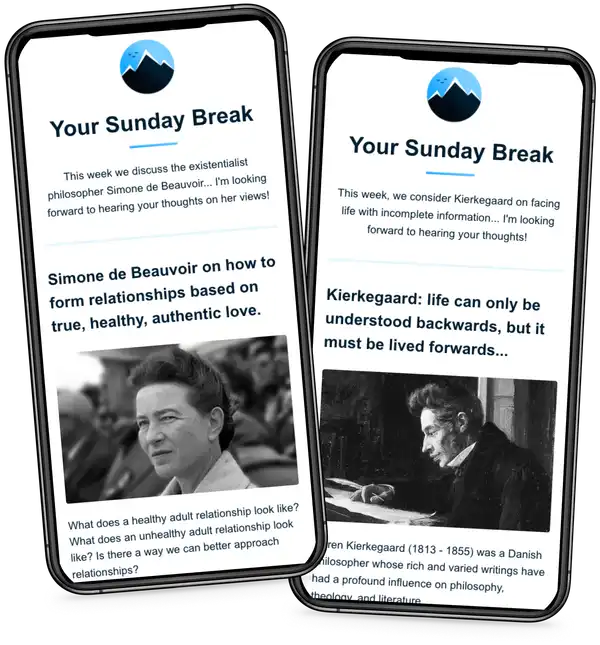
From the Buddha to Nietzsche: join 28,000+ subscribers enjoying my free Sunday Breakdown
In one concise email each Sunday, I break down a famous idea from philosophy. You get the distillation straight to your inbox.
💭 One short philosophical email each Sunday. Unsubscribe any time.


About the Author


Jack MadenFounder
Philosophy Break
👋 My name’s Jack, and I’m the Founder and Director of Philosophy Break. I’m the author of The Philosophy Prescription: Lessons from Big Thinkers for Every Stage of Life (Penguin Random House, 2026). Learn more about me and Philosophy Break here.
If you enjoy learning about humanity’s greatest thinkers, you might like my free Sunday email. I break down one mind-opening idea from philosophy, and invite you to share your view.
Subscribe for free here, and join 28,000+ philosophers enjoying a nugget of profundity each week (free forever, no spam, unsubscribe any time).


Take Another Break
Each break takes only a few minutes to read, and is crafted to expand your mind and spark your philosophical curiosity.


Get one mind-opening philosophical idea distilled to your inbox every Sunday (free)


From the Buddha to Nietzsche: join 28,000+ subscribers enjoying a nugget of profundity from the great philosophers every Sunday:
★★★★★ (100+ reviews for Philosophy Break). Unsubscribe any time.
