
Jorge Luis Borges: When We Die, What Dies With Us?
The Witness: a beautiful, haunting, 4-paragraph short story from the great Jorge Luis Borges that asks: when people die, what dies with them?


The Witness, by Jorge Luis Borges (taken from the 1965 collection, A Personal Anthology, translated by Anthony Kerrigan):
In a stable lying almost in the shadow of the new stone church, a man with gray eyes and a gray beard, stretched on the ground amidst the animal odors, meekly seeks death like someone seeking sleep. The day, faithful to vast secret laws, continuously displaces and confounds the shadows in the wretched stable. Outside stretch the tilled fields, a deep ditch filled up with dead leaves, and the tracks of a wolf in the black mud where the woods begin.
The man sleeps and dreams, forgotten. The bells calling to prayer awake him. In the kingdoms of England, the sound of the bells is already one of the customs of the afternoon, but the man, while still a boy, had seen the face of Woden, had seen holy dread and exultation, had seen the rude wooden idol weighed down with Roman coins and heavy vestments, seen the sacrifice of horses, dogs, and prisoners. Before dawn he would be dead and with him would die, never to return, the last firsthand images of the pagan rites. The world would be poorer when this Saxon was no more.
We may well be astonished by space-filling acts which come to an end when someone dies, and yet something, or an infinite number of things, die in each death—unless there is a universal memory, as the theosophists have conjectured. There was a day in time when the last eyes to see Christ were closed forever. The battle of Junín and the love of Helen died with the death of some one man.
What will die with me when I die? What pathetic or frail form will the world lose? Perhaps the voice of Macedonio Fernandez, the image of a horse in the vacant space at Serrano and Charcas, a bar of sulfur in the drawer of a mahogany desk?
Does Borges’s short story touch on themes you’ve thought about before?
Borges is not the only thinker to dwell on what’s lost in death. Here’s existentialist philosopher Simone de Beauvoir, for instance, in her 1963 memoir, Force of Circumstance:
I think with sadness of all the books I’ve read, all the places I’ve seen, all the knowledge I’ve amassed and that will be no more. All the music, all the paintings, all the culture, so many places: and suddenly nothing. They made no honey, those things, they can provide no one with any nourishment. At the most, if my books are still read, the reader will think: There wasn’t much she didn’t see!
But that unique sum of things, the experience that I lived, with all its order and its randomness – the Opera of Peking, the arena of Huelva, the candomblé in Bahía, the dunes of El-Oued, Wabansia Avenue, the dawns in Provence, Tiryns, Castro talking to five hundred thousand Cubans, a sulphur sky over a sea of clouds, the purple holly, the white nights of Leningrad, the bells of the Liberation, an orange moon over the Piraeus, a red sun rising over the desert, Torcello, Rome, all the things I’ve talked about, others I have left unspoken – there is no place where it will all live again.
Every human being contains a unique kaleidoscope of memory and feeling. Where does that kaleidoscope go?
If our ‘stuff’ is of the same ‘stuff’ as the cosmos, are the images we carry stored somewhere? Is the substance of which we are an expression eternal, as Spinoza hinted?
Or, as Nietzsche articulates it in his Untimely Meditations, is everything we are just a singular flash, never to be seen again?
At bottom every human being knows well enough that he is a unique being, only once on this earth; and by no extraordinary chance will such a marvelously picturesque piece of diversity in unity ever be put together a second time.
What do you think? What dies with us when we die?
To inform your reflections, you might enjoy the following related Philosophy Breaks:
- Heidegger: We Are Time Unfolding (and our Time is Finite)
- Pantheism: Spinoza and the God that Einstein Believed In
- Anicca: Our Collective Way of Life Won’t Exist Soon
- Epicurus On Why Death Should Not Concern Us
If you enjoyed this article, consider subscribing to my free Sunday breakdown. I distill one famous idea from philosophy each week; you get the summary delivered straight to your email inbox, and are invited to share your view. Consider joining 26,000+ subscribers and signing up below:
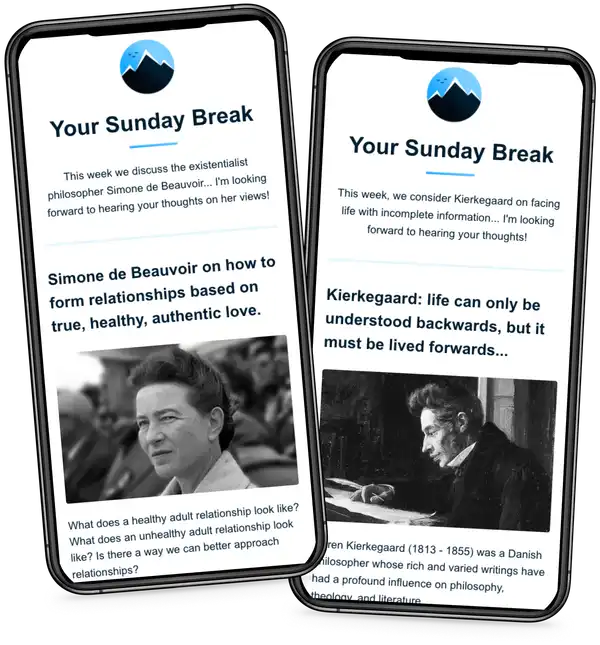
From the Buddha to Nietzsche: join 26,000+ subscribers enjoying my free Sunday Breakdown
In one concise email each Sunday, I break down a famous idea from philosophy. You get the distillation straight to your inbox.
💭 One short philosophical email each Sunday. Unsubscribe any time.
About the Author


Jack MadenFounder
Philosophy Break
👋 My name’s Jack, and I’m the Founder and Director of Philosophy Break. I’m currently writing a book, The Philosophy Prescription, which is due for publication by Torva (Penguin Random House) in Autumn 2026. Learn more about me and Philosophy Break here.
If you enjoy learning about humanity’s greatest thinkers, you might like my free Sunday email. I break down one mind-opening idea from philosophy, and invite you to share your view.
Subscribe for free here, and join 26,000+ philosophers enjoying a nugget of profundity each week (free forever, no spam, unsubscribe any time).
Get one mind-opening philosophical idea distilled to your inbox every Sunday (free)


From the Buddha to Nietzsche: join 26,000+ subscribers enjoying a nugget of profundity from the great philosophers every Sunday:
★★★★★ (100+ reviews for Philosophy Break). Unsubscribe any time.
Take Another Break
Each break takes only a few minutes to read, and is crafted to expand your mind and spark your philosophical curiosity.


