


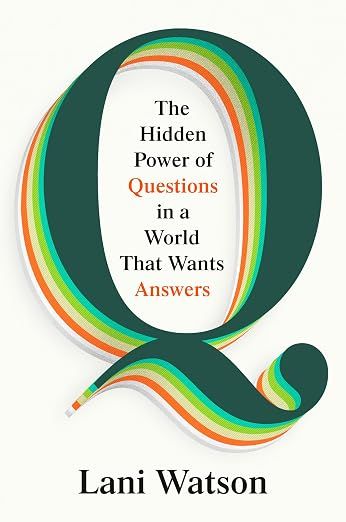
Q: The Hidden Power of Questions in a World That Wants Answers
BY LANI WATSON

According to the philosopher Lani Watson, our capacity to ask questions is among humanity’s most distinctive evolutionary superpowers. Rather than cultivate this power, however, today’s world erodes it: education, work, and technology increasingly rush us towards answers.
The Debate Of Socrates And Aspasia, by Nicolas-André Monsiau (1801), via Wikimedia Commons
Dr Lani Watson is an Honorary Fellow at the University of Edinburgh. She is fascinated by questions: what they are, why we ask them, and how we can harness their power for good. Drawing on philosophy and experimental psychology, her research investigates the practice of questioning in everyday life.
I interviewed Lani about her brilliant new book, Q: The Hidden Power of Questions in a World That Wants Answers, where she argues that in our rush towards answers, we lose sight of how crucial it is to sustain a questioning mindset.
After all, it is questions that set the course. If we aren’t asking the right questions, then the answers are totally irrelevant. Questions not only prepare the ground for all that follows, they have the power of opening our minds, directing our attention, and transforming human society.
Lani’s book details the evolutionary history of humanity’s capacity for asking questions, and why it’s among the most crucial contributors to our success as a species. She then discusses how today’s education, work, and technology undermine this capacity, and the benefits we might reap by shifting from an answering to a questioning mindset.
I hope you enjoy reading mine and Lani’s discussion as much as I enjoyed having it!
When we reflect on the nature of questions, we might think that it’s just something to do with our language. But the actual substance and practice of questioning is so much deeper within our conceptual apparatus and within our evolutionary history.
I think what’s fascinating is how far back you have to go to get to the beginning of this evolutionary story: we have to go millions and millions of years further back than language.
It starts with what I call proto-questioning, which is the exploratory, information-seeking behaviour found in very basic forms of life, like a nematode worm searching for a food source. This sort of foraging is hardwired and not done intentionally.
Then comes the evolutionary leap to private questioning, which involves a complex set of abilities that permit an organism to intentionally direct its attention towards the goal of eliciting information.
That’s when we get true questioning because that’s when an organism can actually decide that it needs or wants some information and then go out and try and get that information.
Once private questioning evolved, it must have quickly expanded throughout the animal kingdom as it’s clearly extremely valuable to basically every species on Earth, aside from those really simple organisms, to acquire information intentionally in this way. It gives them the capacity to problem solve in a much more powerful, deliberate way.
New environments, new threats, avoiding the predator coming round the corner, finding the really rich source of food: information gathering is incredibly important.
And then, what follows is in some ways even more important for humans because we have this amazing leap from private questioning to social questioning, which I argue in the book only humans have made.
So this means that humans are the only species that asks each other questions. That may seem surprising, but that’s the conclusion suggested by my research.
Social questioning is incredibly powerful for humans because it allows us to not only intentionally gather information from our environment, but to do so in this very efficient way by getting it from each other. So we don’t all have to start from scratch and literally reinvent the wheel every time.
I think that’s essentially the foundation of cultural evolution: our ability to learn in a really, really efficient way from each other and pass down knowledge through generations so that humanity manages to progress.
This is unlike, say, chimpanzees who don’t really learn generationally to anything close to that extent. They learn from each other by watching - how to use special tools, for example - and that sometimes gets passed down through generations, but it’s nothing like what we do with our deliberate, purposeful questioning of one another.
The famous primatologist, Jane Goodall actually distinguished humanity on this basis. She said,
“What makes us human, I think, is an ability to ask questions.”
From social questioning you then get to the end of the story, which is advanced spoken questioning via the evolution of language. And we know humans are the only species that does this.
But the questions we ask every day using language are all underpinned by these incredible evolutionary advances in our ability to acquire information in new and more efficient, effective, and powerful ways over hundreds of millions of years.
Whenever I speak to anyone in education they are usually 100% on board with the idea that students should be asking their own questions in the classroom, but they don’t have the opportunity to really facilitate it.
Many teachers understand the learning power of questions, not to mention their greater effects on confidence, autonomy, and agency; but their hands are tied by the system, and it frustrates them.
I don’t think we need a huge revolution to change things, but there does need to be a shift. It can start by understanding, not just at the teaching level but at the curriculum and assessment levels, just how important the power of questions really is.
You just have to look at the neurochemistry to see what a powerful learning tool questions are because questions that spark curiosity actually change the chemistry in our brains and help us to process and remember things.
When you think about the learning that we do as young infants, and then all the way through the first years of our lives, you quickly see that we use questions in this extremely efficient and powerful way to learn everything that we can. But as soon as we enter school, that starts to decline.
That’s partly because the people doing the vast majority of asking in classrooms are teachers, not students. Students quickly transition to being answerers rather than askers when they get to school.
But it doesn’t make any sense that you put questions, this extremely powerful learning tool, into the hands of the teachers instead of the students. Because it’s not teachers who need to do the learning.
Teachers can use questions to facilitate learning, but what we really need is students to be asking the questions for themselves in order to prompt that powerful neurochemical effect that allows them to actually learn in this really, really efficient way.
And then in terms of how we evaluate that, I don’t think it’s actually hard to do when you think about how evaluation already takes place.
When you assess a student’s essay or creative writing story, you’re not assessing a black-and-white factual answer. You’re assessing something more subjective, and we can do the same with questions.
It’s about making judgments about whether a question is getting at useful information, whether it’s being asked in the right way and of the right source and so on. We can assess questions the same way we assess any answer that isn’t simply true or false, because we enter into some subjectivity right from the outset.
Yes, that directions example is a good one. As a result of constantly turning to screens or devices instead of each other, we miss opportunities to establish social touchpoints that create a connection; but for me, the important thing is that the exchange of reliable information between human beings is a foundation of trust. If we don’t do that, we can’t establish that sense of trust in other human beings as well or as effectively.
Social questioning has given us this incredible power to connect, coordinate, collaborate, and learn from each other, and as a result, we learn to trust one another.
Instead of doing that I look at my phone, and now what do I trust? I trust Google Maps because it is reliable and good at getting me from A to B: I place my trust in that device instead of the human beings around me to get me where I’m going, and that becomes writ large for everything.
We trust Claude. We trust ChatGPT. Hopefully not blindly. But turning to technology instead of humans is eroding our ability to trust each other, because we aren’t having that experience of information exchange, which in my view has grounded a lot of our species’ success.
Someone I think is underrecognised and undervalued in the ethical discussion around technology is the philosopher Jacques Ellul. His view is that technology itself is ethics.
Rather than adding ethical considerations onto the backend, we have to understand the development of technology as already entirely bound up with ethical decision-making. It is always an answer to the question of how we want to live, both at a societal level and on a personal level.
When you break it down, you realise how many of these ethical decisions you are making all the time when you make choices about technology: you have views about the screen time you want in your life and the types of technology you use, for example. I think about the tech-ethical choices I am making for my daughter: I have views about her screen time and how I want her to engage with technology.
We are constantly making decisions about our personal engagement with technology that reflect an answer to the question, “How do I actually want to live?” I think we should be foregrounding that question and not letting it slide into the background of our lives.
A quiet revolution. There does need to be a mindset shift. In the book, I talk about the move from an answering mindset to a questioning mindset. That is a way to envisage a future that is more question-oriented.
In my opinion, it is not going to come from technology or a technological fix. As the person I spoke to at DeepMind insisted, all of this AI technology needs two things: data and questions. If you do not probe it with questions, interrogate it, and give it problems to solve, it is not doing anything: it is inert, just sitting there.
Once we truly understand how to take the power back from that technology, recognising that it rests in human minds and human hands to interrogate and probe the data and use it in a way that answers the overriding question of how we actually want to live, then a shift is possible.
It is not going to come from building lots of technology that comes up with great questions for us. Instead, it will come from a human-centred recognition that we have this incredible power of asking questions, and can use it to direct technology in our individual lives as well as at a social level.
Right now, individuals can decide what question to ask Google or Claude, or whether to turn to a friend sitting next to them or a colleague across the desk and ask. If we choose the human, we are taking the power of questions and using it to enhance our social connections and continue to build trust in each other, instead of machines.
We have that power all the time. We are constantly making decisions about whom we ask, what questions we ask, and when, how, and why.
By more consciously using that power, a shift is possible that no doubt includes this powerful technology, but without being dominated by it and giving up one of the most distinctive things we do as humans.
There are three elements I talk about in the book. The first is just noticing the power of questions, and doing the work of seeing where questions are popping up. It's simply recognising when you're asking questions and when you're being asked questions, and the effect that's actually having in your life. (You’ll probably realise you're using them all the time and wonder why you haven't noticed that before.)
The second component of that mindset is starting to think in questions – a kind of question-first approach. Instead of rushing to answers, you approach that conversation, meeting, problem, or situation with questions first. That's a way of not just recognising the power, but starting to use it.
The third component is questioning well. A key to that is the “know thyself” maxim, that ancient Greek idea that self-knowledge is the start of change in many ways.
I have a questioning strengths assessment, which is one tool for learning about who you are as a questioner. It's a free online psychometric assessment that gives you a profile of your unique approach to questioning across eight different questioning strengths.
People can then use that to think, “Okay, I've come out as an Investigator, someone who digs into the details and gets to the bottom of things effectively, yet I've scored less well on my Engager profile, so perhaps I'm not so good at asking questions that build rapport and make connections. Now I'm going to look at where there are situations where I could move out of Investigator-type questioning and into Engager-type questioning.”
Right: it’s all about context. You begin to recognise, “okay, maybe my training as, say, a philosopher has skewed me towards a certain questioning approach that doesn’t always go down well.”
Understanding who you are as a questioner is an important starting point. But to accompany the book, I’ve also created a practical course, How to Build a Questioning Mindset, which teaches you how to really fully apply the power of questions throughout your life. That will be coming out early in 2027 and you can sign up now to be notified.
Questions are so central to how philosophy operates, and in particular, it is a pursuit of questions and not answers that keeps philosophy alive.
We are literally asking the same question, how to live a good life, which is straight out of the playbook of every ancient philosophical tradition you can think of. That question is still one we don't have an answer to, so does that make it not worth asking? Surely not.
Part of the reason comes back to this point about power. If you miss the power of questions, if you're rushing past the question in order to get to the answer, you're missing the only opportunity you have to affect what that answer ends up being.
You’re missing your chance to change the information you end up with, the knowledge you end up with, the connection you make, and the trust you establish.
All that power to change things comes from asking the questions; it doesn't come from ending up with the answer.
Philosophy, in general, is doing that, but at scale: it’s embracing this opportunity to change so much about the conversation.
It might be simply the conversation you're having in your own head – a back-and-forth of questions and answers with yourself – or it might be the conversation you're having with a colleague, a friend, a loved one, a child, a teacher, or a boss.
All of that is mediated through question-and-answer exchange. If we don't take the opportunity to sit with the questions and think about how we're directing those exchanges and conversations, we're missing the opportunity to actually have an impact on them.
Philosophy gives us that opportunity to sit with questions, to sit with uncertainty, and to sit with doubt – to recognise that others have been sitting with it, and all these generations of thinkers before have also been sitting with it, that as a species we’ve sat with it for thousands of years.
It lets us really embrace the lack of answers in a way that can filter out into other parts of your life, if you let it become part of how you approach people and the world.
I think of philosophy as training to live with that kind of uncertainty: it encourages you to embrace what’s powerful and important about being in an uncertain world. And that’s exactly a questioning-mindset.
You can order Dr Lani Watson’s book, Q: The Hidden Power of Questions in a World That Wants Answers here, or simply hit the banner below.
To inform your reflections, you might enjoy the following related Philosophy Breaks:
If you enjoy reflecting on themes like those explored in this article, you might like my free Sunday email. I distill one philosophical idea per week, and invite you to share your view.
If you’re interested, you can join 28,000+ thinkers and sign up for free below (no spam, and you can unsubscribe any time):
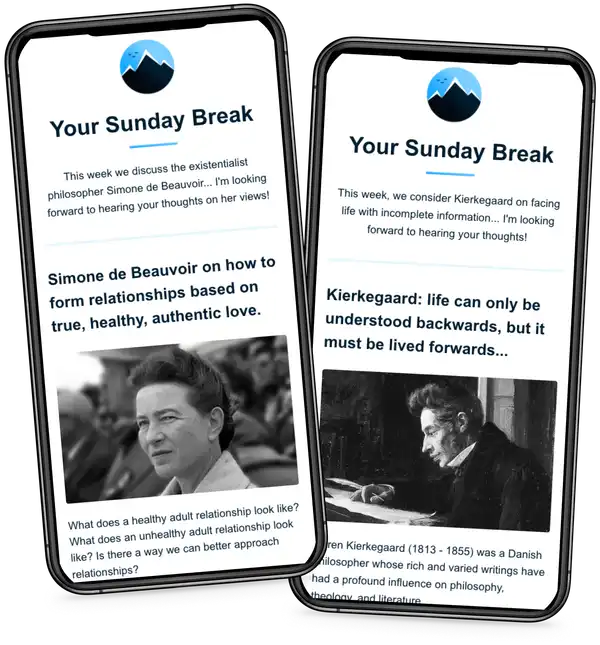
In one concise email each Sunday, I break down a famous idea from philosophy. You get the distillation straight to your inbox.
💭 One short philosophical email each Sunday. Unsubscribe any time.
Jack MadenFounder
Philosophy Break
👋 My name’s Jack, and I’m the Founder and Director of Philosophy Break. I’m the author of The Philosophy Prescription: Lessons from Big Thinkers for Every Stage of Life (Penguin Random House, 2026). Learn more about me and Philosophy Break here.
If you enjoy learning about humanity’s greatest thinkers, you might like my free Sunday email. I break down one mind-opening idea from philosophy, and invite you to share your view.
Subscribe for free here, and join 28,000+ philosophers enjoying a nugget of profundity each week (free forever, no spam, unsubscribe any time).
Each break takes only a few minutes to read, and is crafted to expand your mind and spark your philosophical curiosity.
From the Buddha to Nietzsche: join 28,000+ subscribers enjoying a nugget of profundity from the great philosophers every Sunday:
★★★★★ (100+ reviews for Philosophy Break). Unsubscribe any time.


