
Sanem Soyarslan: to Alleviate Loneliness, Our Hyperconnected Lives Need Better Quality Solitude
Loneliness is rising not just due to less community, suggests the philosopher Sanem Soyarslan, but also from our loss of authentic, nourishing solitude.


Never alone with a phone, via Unsplash
How do you spend your ‘me time’? Maybe it’s going for a walk. Maybe it’s taking a long bath. Maybe it’s reading a book.
Another answer for an increasing number of us, I imagine, is that without thinking we reach for our phones.
Don’t worry, this piece isn’t going to slide into yet another diatribe on phones and screen time. (Look everyone! I’ve found the culprit! It’s our evil phones!)
But unthinking, unintentional screentime is quickly becoming a default state for many humans around the world.
Here I am again, I huff to myself, as I suddenly become conscious of my thumb cycling through apps I have no reason to check.
Sometimes the content on these apps entertains me, sometimes it enrages me; often it just wastes my time.
The writer William Deresiewicz would suggest that what’s particularly troublesome here is not so much the content I space out to; it’s more that my habitual scrolling prevents me from ever entering proper solitude.
In his provocative 2009 essay The End of Solitude, Deresiewicz argues that modern communications have made genuine solitude almost impossible, to the detriment of our individual and collective wellbeing.
If Romanticism had sincerity, and Modernism authenticity, then our own age has visibility as its guiding virtue, Deresiewicz declares.
We exist insofar as we are seen by others: those we deem successful are those with a large profile. We set about gathering followers and connections, and are primed to live our lives almost exclusively in relation to others.
But playing the slot machine of social media acts only as a proxy for connection. As we rake through unending images and commentary, we become trapped in a kind of anticipatory limbo, gaining neither the emotional connection of proper socialising, nor the nourishing rejuvenation of proper solitude.
Deresiewicz is not the first to worry about the proliferation of global information undermining the quality of our ‘me time’.
Goethe expressed concern about the speed of media two centuries ago. In his 1832 Maxims and Reflections, he complains that our impulse to record and stay ‘current’ on everything prevents us from truly experiencing anything:
I must hold it for the greatest calamity of our time, which lets nothing come to maturity, that one moment is consumed by the next... so that a man is always living from hand to mouth, without having anything to show for it. Have we not already newspapers for every hour of the day! They publish abroad everything that every one does, or is busy with... No one can rejoice or be sorry, but as a pastime for others; and so it goes on from house to house, from city to city, from kingdom to kingdom, and at last from one hemisphere to the other, all in post haste.
Goethe would presumably be aghast to learn that those newspapers, as well as many citizens’ immediate reactions to them, now sit in the palm of our hands, in a device that beeps and vibrates to ensnare our attention.
Deresiewicz suggests that the growing prevalence of television in the 1960s conditioned people to see idleness as boredom: don’t just sit there, watch TV!
Nowadays, he argues, the ‘always online’ world conditions us to see solitude as loneliness: don’t risk being alone, reach for your phone!
But we all need time away from the hustle and bustle to develop a healthy relationship with our own thoughts, Deresiewicz implores, as well as to foster our own creativity, ideas, and goals for life.
If we drift for too long in a depthless river of drama and information, trying to keep up with what everyone else in the world is up to, we may gradually come to feel the kind of encroaching exhaustion and alienation so acutely articulated by John Muir (from Alaska Days with John Muir):
I am losing precious days. I am degenerating into a machine for making money. I am learning nothing in this trivial world of men. I must break away and get out into the mountains to learn the news.
The philosopher Sanem Soyarslan builds upon these observations. In her 2025 paper Loneliness, Solitude, and Philosophic Contemplation, Soyarslan argues that making space for ‘authentic’ solitude is essential for combating rising social alienation and loneliness.
How can solitude prevent loneliness?
It might seem counterintuitive to advocate solitude as a cure for loneliness, but being alone doesn’t necessarily mean being lonely. Loneliness generally springs from a discrepancy between our desire for social connection and the reality of the connection we’re experiencing, Soyarslan notes. Simply being in the company of other people doesn’t mean you’ll connect with those people.
In fact, Hannah Arendt points out that loneliness often reveals itself most sharply in the company of others.
During a visiting lectureship at UC Berkeley, Arendt wrote a letter to her husband lamenting the relentlessness of the public eye. Her days were spent constantly with others, delivering presentations and making polite small talk.
I imagine we can all recall similar experiences. The corporate away days. Gatherings where we don’t really know anyone. Dinners we can’t wait to leave.
What’s missing here is not the physical presence of other people but a feeling of emotional connection or communion. We do not have the true company of others, and to rub salt in the wound we also lack the space to commune with ourselves.
If only we were alone: perhaps then we wouldn’t feel so lonely!
In her 1953 work The Origins of Totalitarianism, Arendt suggests that the best kind of solitude is a nourishing dialogue with oneself, while in loneliness this dialogue is silenced:
In solitude… I am ‘by myself,’ together with my self, and therefore two-in-one, whereas in loneliness I am actually one, deserted by all others.
“What makes loneliness so unbearable,” Arendt continues, “is the loss of one’s own self which can be realized in solitude.”
For Arendt, then, Soyarslan observes, “not being able to spend time in solitude [during her visiting lectureship] leads to the loss of herself, the ability to keep herself company, as well as the self-reflective space necessary for thinking.”
Think of hermits who feel at one with their environment. They are not brooding over themselves in constant comparison to others, they have transcended this narrow construction of ego to commune with themselves and the world around them.
This is what authentic solitude looks like for Soyarslan: a space in which we can hear ourselves think, keep ourselves good company, and feel anchored in and connected to the here and now of existence.
Unfortunately, this is precisely the space that gets diminished by the daily drama playing out on our phones.
When we scroll between cats and catastrophe, we don’t give our inner dialogue a chance to get going. We do not allow ourselves to transcend the narrow world of human relations, but remain drugged there, passive and unspeaking.
Of course, sometimes we all just need to ‘switch off’. After a busy day, launching into a big dialogue with oneself might seem less appealing than a blissful escape into passivity.
But the worry is that passivity is now our default, that our ‘me time’ is increasingly spent in a switched off state.
Without room for true solitude, away from the ceaseless cacophony on our devices, we lose the ability to think for and be with ourselves.
But if we cannot keep ourselves company, then our only refuge from loneliness becomes the company of others – and the company of others is no guarantee of connection. We may end up mired in unsatisfying relationships, or bleary eyed on social media, or shuffling around a corporate away day, feeling less connected than ever.
What, then, can we do? How can we create space for ourselves to practice authentic solitude? How can we go beyond the noise of Everything Important Happening On Our Phones Right Now?
Well, this is a Philosophy Break article. Can you guess the answer?
That’s right: one sure route away from the daily barrage, Soyarslan suggests, is philosophical contemplation…
Philosophical contemplation can help us cultivate better quality solitude, and thus reduce loneliness
In day-to-day life we are plunged into the everchanging world of human relations. Navigating this world successfully is of course crucial for living a good life, and we rightly dedicate much of our energy to it.
But Soyarslan thinks it’s also important to “recognize that there is more to us, others, and the universe than our anthropocentric circle of private interests.”
In order to recognize this and “enjoy being alone in a relational way”, as with authentic solitude, Soyarslan thinks we need to cultivate a mental space distinct from how we ordinarily occupy the world of daily life. We need to go beyond the idea of ourselves in relation to others, and place ourselves in relation to existence more generally.
One route for this is philosophical contemplation. When we dwell on questions larger than ourselves, questions that other beings have also reflected upon for millennia, we enter a space that stands apart from the dramas of the day. If we listen closely, we might even hear ourselves begin to speak.
In his impassioned rallying cry for philosophy, Bertrand Russell puts it wonderfully:
Philosophy is to be studied, not for the sake of any definite answers to its questions since no definite answers can, as a rule, be known to be true, but rather for the sake of the questions themselves; because these questions enlarge our conception of what is possible, enrich our intellectual imagination and diminish the dogmatic assurance which closes the mind against speculation; but above all because, through the greatness of the universe which philosophy contemplates, the mind also is rendered great, and becomes capable of that union with the universe which constitutes its highest good.
In a similar vein, Soyarslan suggests fostering more philosophical contemplation could help improve people’s capacity for enjoying their own company:
In expanding their scope of interests beyond humanity and their narrow and personal aims, philosophic contemplation may help them construct a mental space, wherein authentic solitude can unfold and they can enjoy being alone together with the company of their thinking self, as well as others, conceived broadly.
Even while physically alone, Soyarslan observes, through contemplation we can feel a kind of communion that goes “beyond human-centric interactions”, and helps us experience “alternative forms of relatedness in a different kind of mental space that distances [us] from the physical and social realities of everyday life.”
If we manage to cultivate a space of mental calmness, tranquility, and even awe through following our curious contemplation, we might begin intentionally choosing our own company over inadequate alternatives.
We might increasingly appreciate that the answer to loneliness is not more social media, not more bad relationships, but fostering a deeper communion with the world through solitude.
What if we start enjoying our own company a bit too much?
Cultivating authentic solitude isn’t without its own problems, Soyarslan warns: we may end up enjoying our own company so much that we begin to resent other people!
The philosopher Arthur Schopenhauer is a good example here. With his famous porcupine dilemma, he ends up concluding that other people are so utterly incapable of offering us the connection we crave that it’s probably a better idea to stop trying, and withdraw to a blissful, solitary life of cultural cultivation and refinement.
It is, of course, a balance. And the good life no doubt requires good company from others as well as from ourselves.
Currently, however, with cannonballs of information firing at us every second, with visibility as our chief virtue, with social media driving endless comparison, perhaps the scales need resettling. Perhaps culture must rediscover and celebrate the importance of solitude.
If we really want to protect ourselves from feelings of loneliness and alienation, maybe we should turn away from that which so slyly promises to ease them.
Take a breather from the social networks. Stop viewing ourselves exclusively in relation to others. Start keeping ourselves proper company.
What do you make of Soyarslan’s analysis?
- Do you enjoy your own company?
- Do you think genuine solitude is harder to access nowadays?
- Do you agree that social media encourages us to live exclusively in relation to others, acting only as a proxy for connection, or have you found genuine connection through it?
- What do you make of Arendt’s characterisation of solitude as keeping oneself company?
- Could better solitude stave off loneliness?
- Could philosophical contemplation be a route for better solitude?
- Beyond philosophy, what other pursuits or pastimes have you found create space for authentic, even transcendent solitude?
- When have you most felt a sense of communion with the world?
Soyarslan’s analysis particularly resonated with me, which is probably unsurprising given its championing of philosophy. She’s preaching to the choir!
But with the Philosophy Break community, as well as in the writings of curious beings throughout history (the “millenia-spanning community” that I discuss in the introduction to my book), I really do feel the sense of universal communion Soyarslan mentions. We aren’t together physically, yet here we are in solitude, reflecting alone together.
To inform your reflections on this particular topic, you might enjoy the following related articles:
- The Porcupine’s Dilemma: Schopenhauer’s Wistful Parable On Human Connection
- Bertrand Russell On Why Philosophy Matters
- Ralph Waldo Emerson’s Self-Reliance Summary: Become Your Own Person
- Ubuntu Philosophy: Wealth Resides in the Health of the Community
- True Wealth Lies in Friendship: Epicurus and Ho Kepos
- Hannah Arendt On Standing Up to the Banality of Evil
Get one famous philosophical idea in your inbox each Sunday
If you enjoyed this article, you might like my free Sunday breakdown. I distill one piece of wisdom from philosophy each week; you get the summary delivered straight to your email inbox, and are invited to share your view. Consider joining 28,000+ subscribers and signing up below:
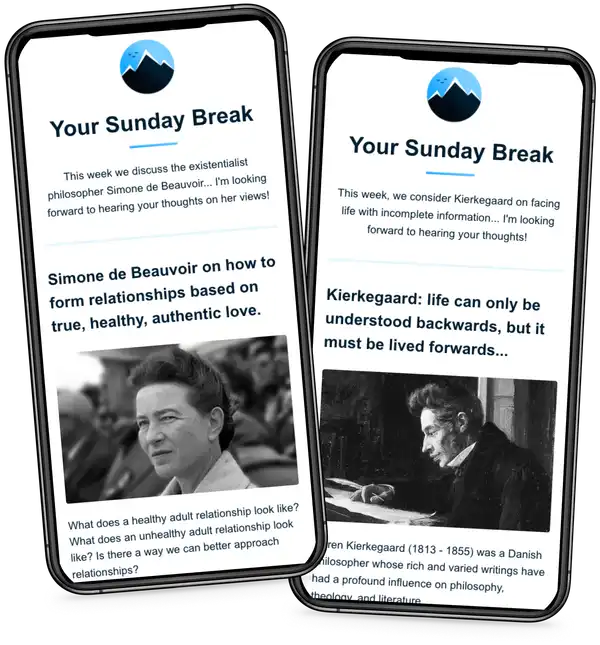
From the Buddha to Nietzsche: join 28,000+ subscribers enjoying my free Sunday Breakdown
In one concise email each Sunday, I break down a famous idea from philosophy. You get the distillation straight to your inbox.
💭 One short philosophical email each Sunday. Unsubscribe any time.


About the Author


Jack MadenFounder
Philosophy Break
👋 My name’s Jack, and I’m the Founder and Director of Philosophy Break. I’m the author of The Philosophy Prescription: Lessons from Big Thinkers for Every Stage of Life (Penguin Random House, 2026). Learn more about me and Philosophy Break here.
If you enjoy learning about humanity’s greatest thinkers, you might like my free Sunday email. I break down one mind-opening idea from philosophy, and invite you to share your view.
Subscribe for free here, and join 28,000+ philosophers enjoying a nugget of profundity each week (free forever, no spam, unsubscribe any time).


Take Another Break
Each break takes only a few minutes to read, and is crafted to expand your mind and spark your philosophical curiosity.


Get one mind-opening philosophical idea distilled to your inbox every Sunday (free)


From the Buddha to Nietzsche: join 28,000+ subscribers enjoying a nugget of profundity from the great philosophers every Sunday:
★★★★★ (100+ reviews for Philosophy Break). Unsubscribe any time.
