
Three Philosophers, Three Ways to Rethink the New Year
Whether you’re into setting New Year’s resolutions, or you’re more of the opinion that formulating goals for the next twelve months is a waste of time, which philosophical perspective most resonates with you?


Happy New Year, philosophers! I thought I’d kick off 2026 with a brief reflection on how three different thinkers might recommend we face the year ahead.
Whether you’re into setting New Year’s resolutions, or you’re more of the opinion that formulating goals for the next twelve months is a waste of time, which philosophical perspective most resonates with you?
1. Kieran Setiya: focus on valuable processes rather than outcomes
Remaining totally unmoved by the seductive New Year promises of rebirth, growth, and possibility is surely a challenge for even the most hardened of cynics... another spring awaits!
But, as philosophers, we must ask: if we do seek to improve our lives this year, what sort of resolutions should we be setting? Are certain kinds better or wiser than others?
For example, be it committing to learning a new skill, embarking on an exercise program, or even writing detailed five-year plans, many New Year’s resolutions take the form of projects.
And, typically, these projects are centered around shiny rewards. A stronger, fitter, healthier body; a bigger bank balance; an impressed peer group. With these kinds of resolutions, our eyes are on the prize: in the future, our lives will be better.
While it may be tempting to focus on the outcome of projects, however, contemporary philosopher Kieran Setiya suggests doing so risks draining value from our everyday activities.
“We tend to be, I think, a little bit too obsessed with project-like structures in our lives,” Setiya remarks in an interview I conducted with him a couple of years ago:
When you’re focusing on a project, you’re aiming at something in the future, and then as soon as you achieve it, it’s over. What you’re doing is taking this thing that’s structuring your life and attempting to finish it – and thereby getting rid of the source of meaning in your life. The more you focus on things like that, the more you risk setting yourself up for evaluating your life in terms of success and failure. But it’s important to remember that not all activities are like that.
Setiya draws a distinction between telic activities and atelic activities, terms which originate from the Greek word telos, meaning ultimate object or aim:
While there are telic projects which aim at some sort of end state where they’re achieved, there are also atelic activities that don’t aim at a goal in this way. While you’re walking home, for instance, you’re also just walking, and there’s pleasure to be found in just walking with no urgent destination in mind.
Many New Year’s resolutions tend to be telic in structure: they aim at a desired future state. Setiya reminds us, however, that it is atelic activities that actually fill our days:
The more we recognize the value of the atelic activities we’re engaged in on a daily basis – like walking, eating, interacting with our loved ones – the less we’re structuring our lives entirely in terms of projects that will succeed or fail.
If setting resolutions, then, we should ask ourselves not just who we want to be in the future, but who we want to be day-to-day, on the way to that future. As Setiya puts it:
To some extent you can reframe this in terms of thinking about processes as primary and projects as secondary: that we engage in certain kinds of projects in order to be engaged in certain valuable processes.
In other words, we identify the activity first, and then build a project around it. The activity itself holds value, not just whether we achieve some kind of result from it.
What kind of activities do you enjoy? Walking? Reading? Learning? Debating? Cooking? Drawing? Painting? Interacting with loved ones? Playing an instrument? Dancing? Being a good friend? Hiking? Gardening? Playing a sport?
What kind of projects would enable you to do more of those activities this year?
Maybe the best resolutions are made not when we obsess over some arbitrary future goal, nor when we crave a particular result, but simply when we promise ourselves we’ll commit more time to the atelic activities that nourish our souls.
For more in this vein, you might enjoy the following related Philosophy Breaks:
- How To Set Better New Year’s Resolutions: Focus On Processes, Not Outcomes
- ‘Dao’ in Chinese Philosophy: Harmonizing with the Way
2. Susan Wolf: find activities worthy of your engagement
Setiya urges us to focus on engaging with the process, but is that enough? Is engagement all we need for a happy and meaningful year ahead? Or does what we’re engaged in matter too?
If we seek to cultivate more meaning and fulfillment in 2026, there are two recommendations that might come to mind:
- Follow your passion. Here the idea is simply to discover what drives you, to establish what gets you out of bed in the morning, and then to build your life around it. It could be big or small, so long as you love what you do, you will live a meaningful life.
- Commit to something larger than you are. Here the idea is that meaning comes from dedicating yourself to something worthwhile. It’s not so much about your subjective love for the cause; it’s about the cause itself. If you’re committed to a worthy cause, you will live a meaningful life.
Each of these hits on something important, we might think, but contemporary philosopher Susan Wolf suggests that on their own neither is quite right.
If we follow our passion, for example, what if that passion is counting individual blades of grass in different fields? What if it’s sitting on the sofa and watching repeats of The Office on TV all day? What if it’s pushing a boulder up a mountain, only for it to roll back down when we reach the top?
Though perhaps personally engaging, could lives dedicated to such pursuits really be described as significantly meaningful?
But then, on the other hand, say we commit to a cause larger than we are, like reducing global poverty.
What if our particular role in doing so involves repetitive administrative work we find utterly mind numbing? Is feeling alienated from our daily work redeemed by the larger cause? Does the larger cause suddenly render the daily drudgery meaningful, even if we are forever bored and going through the motions?
Wolf thinks not: attaching ourselves to larger causes does not guarantee meaning, but nor does meaning come from passion alone.
Rather, meaningfulness arises through a combination of the two: our lives are meaningful when we lovingly, actively engage with worthwhile projects, when subjective passion meets objective worth.
On Wolf’s view, then, there is both a personal qualitative aspect and an impersonal objective component to meaning. A meaningful life is filled with projects that offer both, she writes:
a life is meaningful insofar as its subjective attractions are to things or goals that are objectively worthwhile. That is, one’s life is meaningful insofar as one finds oneself loving things worthy of love and able to do something positive about it. A life is meaningful… insofar as it is actively and lovingly engaged in projects of worth.
For Wolf, meaning thus comes from “active engagement in projects of worth, which links us to the world in a positive way.” Our lives are meaningful when we love what we do and when what we do matters.
But who’s to say what matters? You can see how Wolf tackles this question in my fuller exploration of her philosophy: Susan Wolf on How to Live a Meaningful Life.
For our purposes here, however, facing the year ahead: if we long for more meaning in our lives, if we feel a little alienated or bored, then Wolf suggests the formula for a remedy is relatively simple: find something to love, ensure its value does not come only from your love, and try to contribute something positive towards it.
3. Friedrich Nietzsche: love what happens
Put plans, projects, and processes to one side for a moment: what attitude will we bring to 2026? How will we face whatever the world throws at us?
19th-century German philosopher Friedrich Nietzsche, for instance, suggests the new year fills him with a spirit of openness. He expresses his wish to live according to amor fati, love of fate:
For the new year. – I still live, I still think: I still have to live, for I still have to think… Today everybody permits himself the expression of his wish and his dearest thought: hence I, too, shall say what it is that I wish from myself… I want to learn to see more and more as beautiful what is necessary in things; then I shall be one of those who makes things beautiful. Amor fati: let that be my love henceforth! I do not want to wage war against what is ugly. I do not want to accuse. Looking away shall be my only negation. And all and all and on the whole: someday I wish to be only a Yes-sayer.
This famous passage from Nietzsche's 1882 work The Gay Science offers an early blueprint for his Übermensch figure, someone who overcomes convention and self-pity to say yes to everything that comes their way.
To learn more about Nietzsche's provocative take on amor fati (love of fate), as well as his Übermensch, you might enjoy the following Philosophy Breaks:
- Amor Fati: the Stoics’ and Nietzsche’s Different Takes on Loving Fate
- Übermensch Explained: the Meaning of Nietzsche’s ‘Superman’
- Eternal Recurrence: What Did Nietzsche Really Mean?
What perspective will you bring to the New Year?
- Do you have any resolutions for the new year?
- Will you be focusing more on projects or processes? Which activities matter to you?
- What attitudes and guiding principles will you try to adopt throughout 2026?
If you enjoyed this article, you might like my free Sunday breakdown. I distill one piece of wisdom from philosophy each week; you get the summary delivered straight to your email inbox, and are invited to share your view. Consider joining 25,000+ subscribers and signing up below:
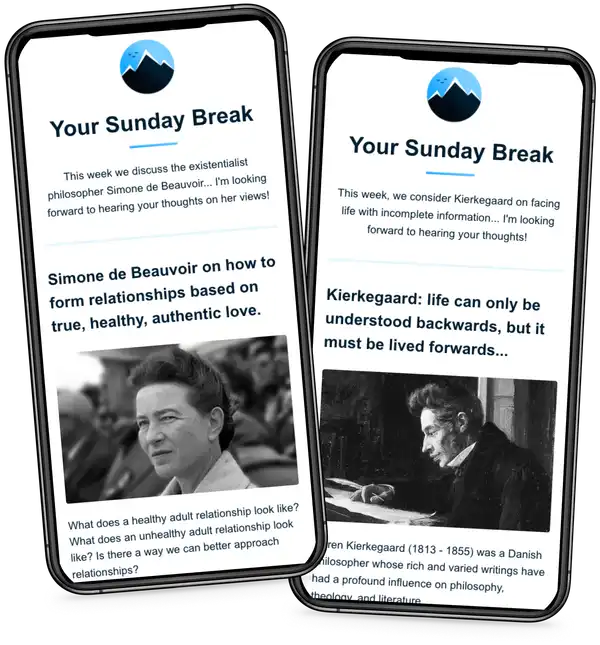
From the Buddha to Nietzsche: join 25,000+ subscribers enjoying my free Sunday Breakdown
In one concise email each Sunday, I break down a famous idea from philosophy. You get the distillation straight to your inbox.
💭 One short philosophical email each Sunday. Unsubscribe any time.
About the Author


Jack MadenFounder
Philosophy Break
👋 My name’s Jack, and I’m the Founder and Director of Philosophy Break. I’m currently writing a book, The Philosophy Prescription, which is due for publication by Torva (Penguin Random House) in Autumn 2026. Learn more about me and Philosophy Break here.
If you enjoy learning about humanity’s greatest thinkers, you might like my free Sunday email. I break down one mind-opening idea from philosophy, and invite you to share your view.
Subscribe for free here, and join 25,000+ philosophers enjoying a nugget of profundity each week (free forever, no spam, unsubscribe any time).
Get one mind-opening philosophical idea distilled to your inbox every Sunday (free)


From the Buddha to Nietzsche: join 25,000+ subscribers enjoying a nugget of profundity from the great philosophers every Sunday:
★★★★★ (100+ reviews for Philosophy Break). Unsubscribe any time.
Take Another Break
Each break takes only a few minutes to read, and is crafted to expand your mind and spark your philosophical curiosity.


