
Elizabeth Anscombe: ‘Morality’ is a Useless Concept; We Have Better Terms to Guide Us
In Modern Moral Philosophy, Elizabeth Anscombe launches a blistering critique on the very concept of ‘morality’. Ethics would be in a better place if we dropped the terms ‘moral’ and ‘immoral’ altogether: we have much more precise language to guide our judgments and actions.


The Spirit of War, by Jasper Francis Cropsey (1851), via Wikimedia Commons
What does it mean to be ‘moral’? What does it mean to be ‘immoral’? Many philosophies and religions have offered answers throughout history. Since the 18th century, however, we could characterize the bulk of Western moral theory by placing Jeremy Bentham in one corner, and Immanuel Kant in the other.
A mob surrounds each philosopher, slinging mud at the other side.
“Morality means maximizing happiness!” yell Bentham’s utilitarians. “Being moral means securing the greatest good for the greatest number!”
“Nein nein nein,” respond Kant’s disciples. “Morality is not about seeking some happy outcome. Being moral means doing the right thing: it’s about respecting rational agency, and adhering to the universal principles of reason.”
Bentham’s approach is a form of what philosophers today call consequentialism: that morality means maximizing good outcomes. If our actions have good consequences, they are moral.
By contrast, Kant’s ethics is a form of what’s known as deontology: that morality means following moral rules and fulfilling duties. The consequences of our actions don’t matter; their moral worth is intrinsic.
For example, Kant argues it’s always wrong to lie. Telling the truth takes precedence over any and all ‘good’ consequences a lie might produce.
But for Bentham’s utilitarians, this rigidity is ridiculous - and dangerous. Is Kant seriously saying that, if the world was about to end, and the only way to save it was to lie to someone, he’d still deem that lie immoral? Clearly the moral thing to do in such circumstances would be whatever it takes to save the world: the ends justify the means…
While many philosophers have been developing these opposing frameworks for the last few centuries, and some have made attempts to unify them, others have expressed frustration with the state of the debate.
Isn’t ethics meant to, you know, help us live a good life? Do we just offer everyone Bentham and Kant, and hope for the best?
20th-century thinker Philippa Foot offers a pithy line that might summarize the complaint here:
If the Martians take the writings of moral philosophers as a guide to what goes on on this planet they will get a shock when they arrive.
What do we actually want from moral philosophy? An increasingly narrow technical debate centered around the binary of ‘morally right’ and ‘morally wrong’? Or might we broaden our horizons a little to better capture the richness, nuance, and variety of living a good life?
Maybe dropping the obsession with ‘morality’ might help us provide a more holistic account of what it means to live a good life in a complicated world…
In her famous 1958 article Modern Moral Philosophy, the English philosopher Elizabeth Anscombe channels such frustrations into a blistering critique about the language used by moral philosophers.
Elizabeth Anscombe: stop spouting rubbish about ‘morality’
While the words ‘moral’ and ‘immoral’ might carry psychological force, Anscombe observes, they don’t actually give us much guidance. In fact, detached from their original theoretical and religious contexts, invoking such terms simply causes confusion.
In the West, our moral notion of ‘ought’ has its roots in Christianity, Anscombe notes: we ought to follow certain rules because God commands it.
Anscombe’s complaint is that modern moral philosophy has more or less abandoned this notion of the divine law, yet clings to its law-like language of ‘ought’, ‘duty’, and ‘obligation’. It wants to dine out on the forceful ‘atmosphere’ and rules-based order of divine morality, while rejecting the divine foundation that lent it force.
Like Bentham and Kant, perhaps in lieu of God we might think we could ground morality in pleasure, or reason, or in some kind of social contract. Anscombe thinks a better route for those who no longer believe in God would be to give up the conception of a law-like framework of ‘morality’ altogether.
Instead of abstract, universal moral principles, philosophers could take inspiration from the pre-Christian notion of ‘ought’, wielded by ancient thinkers like Aristotle.
Just as a plant ‘ought’ to get sunshine and water in order to flourish, perhaps there are things we ‘ought’ to do in order to live a flourishing human life.
Rather than try to force a foundationless ‘top-down’ view (that we must all live in accordance with some universal higher law), we could think more in terms of a ‘bottom-up’ view (that we behave in ways that are conducive to human flourishing).
Anscombe herself thought we needed to build out a philosophy of psychology before proceeding further: until we have a more coherent picture of intention, obligation, and action, we should set moral theory aside.
That doesn’t mean giving up on ethical judgment, or thinking that anything goes. It means questioning whether the abstract language of ‘morality’ - derived from an abandoned conception of the ‘divine law’ - actually hinders more than it clarifies our thinking.
For instance, philosophers can and do debate the definitions of ‘morality’ endlessly. Meanwhile, we have a whole host of virtue and vice terms at our disposal, the definitions of which are already clear.
To see what Anscombe is getting at, suppose someone is sentenced for a crime it’s widely known they haven’t committed.
Utilitarians may debate whether this is ‘moral’ or ‘immoral’ depending on all sorts of contextual and consequential details. Maybe the person is guilty of other heinous crimes, but can only be pinned for this one. Maybe it would prevent a war.
No matter how we switch up the details, however, someone being sentenced for a crime they didn’t commit is the very definition of the term unjust.
“And here we see the superiority of the term ‘unjust’ over the terms ‘morally right’ and ‘morally wrong’,” Anscombe comments:
For in the context of English moral philosophy… it appears legitimate to discuss whether it might be ‘morally right’ in some circumstances to adopt that procedure; but it cannot be argued that the procedure would in any circumstances be just.
Anscombe’s point is that our current discussions of ‘morality’ tend to derive from a law conception of ethics. Philosophers who no longer believe in a universal lawgiver, however, should think twice before adopting the language of ‘morality’. After all, can notions like ‘obligation’ and ‘duty’ really be reconstructed without a legislator?
Without God, Anscombe thinks a law-like conception of moral rules lacks the metaphysical grounding it originally depended upon. Moral philosophy would be in better shape if we dropped this law-centered conception of ‘morality’, stopped trying to preserve the structure of divine law while simultaneously rejecting its source, and instead relied on more precise ethical language.
The revival of virtue ethics
Following her paper, many thinkers saw the wisdom in Anscombe’s view. While Anscombe herself thought our moral concepts require far more development to be of use, her arguments proved pivotal in influencing the revival of virtue ethics.
Virtue ethics has established itself in moral theory as a major rival to consequentialism and deontology, seeking to ground ethics not in abstract law but in human flourishing and character.
Rather than argue endlessly about what constitutes a singular ‘morality’, rather than invoke a top-down, law-like version of ‘ought’ (a hangover from religious conceptions of ethics), philosophers could come back down to earth.
We could better describe and account for the challenging complexity of our lived experience by using the rich, specific moral vocabulary already at our disposal.
Instead of confused or ‘thin’ concepts like ‘morality’, for instance, we could use ‘thick’, action-guiding concepts like ‘truthful’ and ‘untruthful’, ‘just’ and ‘unjust’, ‘loyal’ and ‘disloyal’, ‘courageous’ and ‘cowardly’.
Consider which of these two approaches offers a clearer prescription for living well:
- To live a good life, try not to act in ways that are morally wrong
- To live a good life, try not to act in ways that are selfish, dishonest, disloyal, ungrateful, unsympathetic, thoughtless, rude, arrogant, materialistic, cowardly, jealous, inconsiderate, intolerant, ignorant, irresponsible, etc…
Aristotelianism, Confucianism, Stoicism: none of these moral philosophies needed complicated, law-based conceptions of ‘morality’ in order to inform us about living well.
Rather than ‘morally right’ and ‘morally wrong’, it is action-guiding concepts like courage, wisdom, temperance, kindness, compassion, justice, and integrity - long championed by ancient philosophers from East and West - that show us what it means to develop good character and, accordingly, live a good life.
What do you make of Anscombe’s arguments?
- When you judge your own actions or those of others, do you find terms like ‘moral’ and ‘immoral’ useful? Or do more specific terms like ‘unjust’, ‘dishonest’, or ‘selfish’ better clarify your thinking?
- Do you think those who don’t believe in a universal lawgiver would be better off dropping the concept of a law-centered conception of ‘morality’ altogether, as Anscombe suggests?
- Or, if we did drop ‘morality’ from our descriptions, would something important be lost?
To inform your answers, you might enjoy the following related Philosophy Breaks:
- The ‘Golden Mean’: Aristotle’s Guide to Living Excellently
- The Greatest Happiness of the Greatest Number: What Bentham Really Meant
- God is Dead: Nietzsche’s Most Famous Statement Explained
- Iris Murdoch on the Morality of Attention, and the Hostile Mother-in-Law
- Confucius: Rituals Grind Our Characters Like Pieces of Jade
- The 4 Cardinal Virtues: Stoicism’s Roadmap to the Best Life Possible
- Immanuel Kant: the Best 6 Books to Read
- Ethics and Morality: the Best 10 Books to Read
Get one famous philosophical idea in your inbox each Sunday
If you enjoyed this article, you might like my free Sunday breakdown. I distill one piece of wisdom from philosophy each week; you get the summary delivered straight to your email inbox, and are invited to share your view. Consider joining 26,000+ subscribers and signing up below:
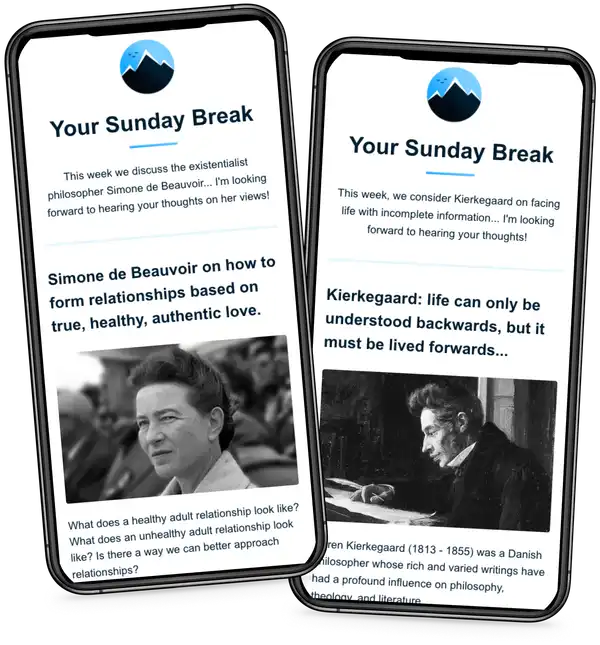
From the Buddha to Nietzsche: join 26,000+ subscribers enjoying my free Sunday Breakdown
In one concise email each Sunday, I break down a famous idea from philosophy. You get the distillation straight to your inbox.
💭 One short philosophical email each Sunday. Unsubscribe any time.
About the Author


Jack MadenFounder
Philosophy Break
👋 My name’s Jack, and I’m the Founder and Director of Philosophy Break. I’m currently writing a book, The Philosophy Prescription, which is due for publication by Torva (Penguin Random House) in Autumn 2026. Learn more about me and Philosophy Break here.
If you enjoy learning about humanity’s greatest thinkers, you might like my free Sunday email. I break down one mind-opening idea from philosophy, and invite you to share your view.
Subscribe for free here, and join 26,000+ philosophers enjoying a nugget of profundity each week (free forever, no spam, unsubscribe any time).
Get one mind-opening philosophical idea distilled to your inbox every Sunday (free)


From the Buddha to Nietzsche: join 26,000+ subscribers enjoying a nugget of profundity from the great philosophers every Sunday:
★★★★★ (100+ reviews for Philosophy Break). Unsubscribe any time.
Take Another Break
Each break takes only a few minutes to read, and is crafted to expand your mind and spark your philosophical curiosity.


