
Erich Fromm: Our Task is Not to Feel Certain, but to Better Tolerate Uncertainty
In this passage from his 1955 work The Sane Society, the philosopher Erich Fromm suggests our task is not to feel certain and secure, but to better tolerate uncertainty and insecurity.


If we feel a sense of uncertainty or insecurity in our lives, the philosopher Erich Fromm seeks to reassure us that this is nothing to worry about. In fact, certainty is no virtue, for the very conditions of our existences preclude certainty and security.
None of us have a God’s-eye view of the cosmos. None of us know what the future holds. All of us are subject to the whims of chance.
It might be tempting to respond to this state of affairs by clinging to some semblance of certainty: to adopt a fixed view on the world or give ourselves over to a comforting dogma.
But doing so always constitutes a leap beyond what we, as limited mortals, can actually know.
Fromm thinks our task, therefore, is not to banish uncertainty, but to reduce our fear of it: to recognize it as a sign of our thoughtful aliveness.
Here’s the full passage from his 1955 work, The Sane Society:
How can a sensitive and alive person ever feel secure? Because of the very conditions of our existence, we cannot feel secure about anything. Our thoughts and insights are at best partial truths, mixed with a great deal of error, not to speak of the unnecessary misinformation about life and society to which we are exposed almost from the day of birth.
Our life and health are subject to accidents beyond our control. If we make a decision, we can never be certain of the outcome; any decision implies a risk of failure, and if it does not imply it, it has not been a decision in the true sense of the word. We can never be certain of the outcome of our best efforts. The result always depends on many factors which transcend our capacity of control.
Just as a sensitive and alive person cannot avoid being sad, he cannot avoid feeling insecure. The psychic task which a person can and must set for himself, is not to feel secure, but to be able to tolerate insecurity, without panic and undue fear.
Life, in its mental and spiritual aspects, is by necessity insecure and uncertain. There is certainty only about the fact that we are born and that we shall die; there is complete security only in an equally complete submission to powers which are supposed to be strong and enduring, and which relieve man from the necessity of making decisions, taking risks, and having responsibilities. Free man is by necessity insecure; thinking man by necessity uncertain.
In other words: far from something to worry about, uncertainty is a condition of a free-thinking life.
Certainty, meanwhile, is to be regarded with suspicion - and Fromm is not the only thinker to warn us of its pitfalls.
“The best lack all conviction,” Yeats declares in The Second Coming, “while the worst are full of passionate intensity.”
As Bertrand Russell reflects in the preface to his History of Western Philosophy:
Uncertainty, in the presence of vivid hopes and fears, is painful, but must be endured if we wish to live without the support of comforting fairy tales.
This is where studying philosophy can help us, Russell advises:
It is not good either to forget the questions that philosophy asks, or to persuade ourselves that we have found indubitable answers to them. To teach how to live without certainty, and yet without being paralyzed by hesitation, is perhaps the chief thing that philosophy can do.
People sometimes criticize philosophy for not making progress: philosophers never agree on anything, and never provide definitive answers.
But loosening ourselves from unwarranted certainty, opening our minds to what things could be, creating reasonable doubt where only dogma existed before: this is also progress. And it’s this kind of progress that philosophy specializes in.
What do you make of these passages?
- Is certainty overrated?
- If we can't forever banish insecurity and uncertainty, how can we better relax into them?
- Is there anything you feel absolutely certain about?
To inform your answers, you might enjoy the following related Philosophy Breaks:
- Bertrand Russell On Why Philosophy Matters
- Ruth Chang on Making Difficult Life Decisions
- Kierkegaard: Life Can Only Be Understood Backwards, But It Must Be Lived Forwards
- The Dichotomy of Control: a Stoic Device for a Tranquil Mind
- Albert Camus on Rebelling against Life’s Absurdity
- Isaiah Berlin On Why the Pursuit of the Ideal is Dangerous
- Why Is Philosophy Important Today, and How Can It Improve Your Life?
Get one famous philosophical idea in your inbox each Sunday
If you enjoyed this article, you might like my free Sunday breakdown. I distill one piece of wisdom from philosophy each week; you get the summary delivered straight to your email inbox, and are invited to share your view. Consider joining 26,000+ subscribers and signing up below:
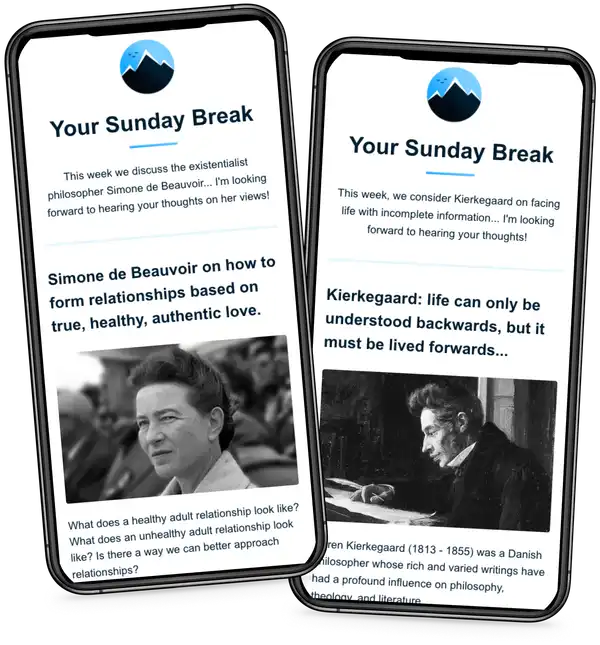
From the Buddha to Nietzsche: join 26,000+ subscribers enjoying my free Sunday Breakdown
In one concise email each Sunday, I break down a famous idea from philosophy. You get the distillation straight to your inbox.
💭 One short philosophical email each Sunday. Unsubscribe any time.
About the Author


Jack MadenFounder
Philosophy Break
👋 My name’s Jack, and I’m the Founder and Director of Philosophy Break. I’m currently writing a book, The Philosophy Prescription, which is due for publication by Torva (Penguin Random House) in Autumn 2026. Learn more about me and Philosophy Break here.
If you enjoy learning about humanity’s greatest thinkers, you might like my free Sunday email. I break down one mind-opening idea from philosophy, and invite you to share your view.
Subscribe for free here, and join 26,000+ philosophers enjoying a nugget of profundity each week (free forever, no spam, unsubscribe any time).
Get one mind-opening philosophical idea distilled to your inbox every Sunday (free)


From the Buddha to Nietzsche: join 26,000+ subscribers enjoying a nugget of profundity from the great philosophers every Sunday:
★★★★★ (100+ reviews for Philosophy Break). Unsubscribe any time.
Take Another Break
Each break takes only a few minutes to read, and is crafted to expand your mind and spark your philosophical curiosity.


