
Pantheism: Spinoza and the God that Einstein Believed In
A quick introduction to the philosophical doctrine of pantheism, and the God that Albert Einstein believed in.


Creation of the World III, by Mikalojus Konstantinas Čiurlionis (1905-6), via Wikimedia Commons
American architect Frank Lloyd Wright once wrote, “I believe in God, only I spell it Nature.” This, in a nutshell, sums up the philosophical doctrine of pantheism, the belief that reality is identical with divinity: that the universe is a manifestation of God.
For pantheists, God is not an anthropomorphic meddler in human affairs, operating outside natural laws – but simply the perpetual being, the uncaused cause of all such laws, that lies at the heart of existence.
There is thus no God but the combined substance, forces, and laws manifest in the universe. Existence itself is divine.
Pantheism was popularized in Western culture as a theology and philosophy largely based on the work of 17th-century philosopher Baruch Spinoza (primarily his book Ethics).
Spinoza suggests we can discover and experience God not through the submissive worship of a transcendent realm, but by using philosophy and science to illuminate the wondrous unity of the world we actually inhabit.
Freedom and enlightenment belong in this reality, not a hidden, imaginary one to which only religious authorities have access. (The religious authorities of Spinoza’s time promptly excommunicated him, following this suggestion.)
While Spinoza is closely associated with pantheism, it should be noted that some scholars argue his philosophy is in fact closer to panentheism, the belief that the universe is ‘in’, rather than the same as, God.
Pantheism: a beautiful metaphysics, or an empty one?
Often misunderstood, pantheism has been deeply influential throughout history. Einstein, when asked by Rabbi Herbert S. Goldstein whether he believed in God, responded:
I believe not in a God who concerns himself with the fate and the doings of mankind, but in Spinoza’s God, who reveals himself in the harmony of all that exists.
The implications of pantheism can be radical. It’s important to remember, for instance, that Nature is not separate from us; we ourselves are Nature.
As late philosopher Helen De Cruz puts it:
Once you realize that you are an expression of the whole of nature, you come to realize that, although you will die, you are also eternal in a non-trivial sense...
On the other hand, 19th-century German philosopher Arthur Schopenhauer complains that “Pantheism is only a euphemism for atheism,” for
to call the world God is not to explain it; it is only to enrich our language with a superfluous synonym for the word ‘world.’
What do you make of pantheism?
- Do you think pantheism is a position worthy of consideration?
- Does placing God in this reality, and banishing the idea of a transcendent realm, resonate with you? Does it move us closer to, say, understanding why anything exists at all?
- Or do you agree with Schopenhauer – that pantheism amounts to nothing more than adding the word ‘divine’ in front of the word ‘nature’, in the hope that this somehow explains it?
To inform your answers, you might enjoy the following related Philosophy Breaks:
- Arne Næss’s Deep Ecology: Reevaluating Our Place in Nature
- On Living Meaningfully in a Vast Universe: Robert Nozick
- ‘Dao’ in Chinese Philosophy: Harmonizing with the Way
- Mono No Aware: Beauty and Impermanence in Japanese Philosophy
- Finding Rapture in the Humdrum: Cultivating Wonder for Everyday Life
Get one mind-opening philosophical idea in your inbox each Sunday
If you enjoy reflecting on themes like those explored in this article, you might like my free Sunday email. I distill one philosophical idea per week, and invite you to share your view.
If you’re interested, you can join 28,000+ thinkers and sign up for free below (no spam, and you can unsubscribe any time):
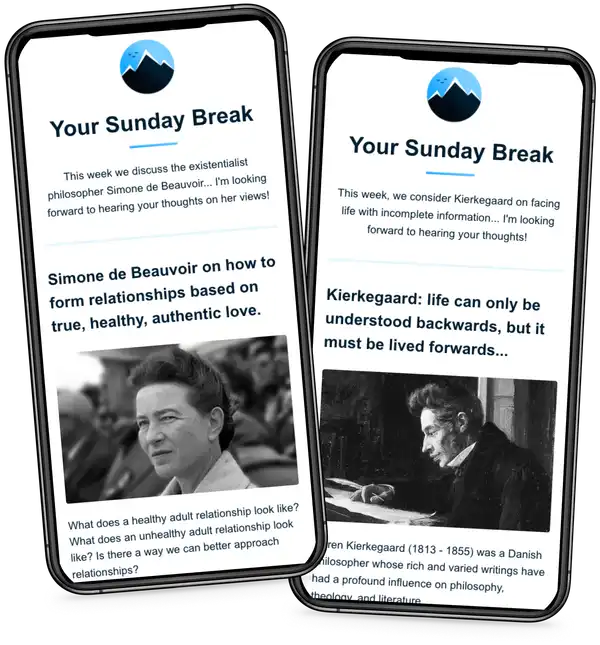
From the Buddha to Nietzsche: join 28,000+ subscribers enjoying my free Sunday Breakdown
In one concise email each Sunday, I break down a famous idea from philosophy. You get the distillation straight to your inbox.
💭 One short philosophical email each Sunday. Unsubscribe any time.


About the Author


Jack MadenFounder
Philosophy Break
👋 My name’s Jack, and I’m the Founder and Director of Philosophy Break. I’m the author of The Philosophy Prescription: Lessons from Big Thinkers for Every Stage of Life (Penguin Random House, 2026). Learn more about me and Philosophy Break here.
If you enjoy learning about humanity’s greatest thinkers, you might like my free Sunday email. I break down one mind-opening idea from philosophy, and invite you to share your view.
Subscribe for free here, and join 28,000+ philosophers enjoying a nugget of profundity each week (free forever, no spam, unsubscribe any time).


Take Another Break
Each break takes only a few minutes to read, and is crafted to expand your mind and spark your philosophical curiosity.


Get one mind-opening philosophical idea distilled to your inbox every Sunday (free)


From the Buddha to Nietzsche: join 28,000+ subscribers enjoying a nugget of profundity from the great philosophers every Sunday:
★★★★★ (100+ reviews for Philosophy Break). Unsubscribe any time.
