
Wittgenstein: If a Lion Could Talk, We Could Not Understand Him
In his Philosophical Investigations, Wittgenstein suggests the meaning of a language is always rooted in a distinctive “form of life”. If alien intelligences live and perceive the world differently enough, understanding their messages may be forever beyond our reach.


The Sleeping Gypsy, by Henri Rousseau (1897), via Wikimedia Commons
Suppose one day we wake to see headlines: ALIEN SIGNALS RECEIVED BY EARTH. The world holds its breath, as clever people around the globe work on decoding the signals.
But after days, weeks, months, years, we seem no closer to interpreting what the signals actually mean.
There are lots of theories: some researchers suggest particular prose translations; others advocate for a kind of mathematical equation.
But there’s no consensus. We don’t understand what the aliens are trying to tell us.
20th-century philosopher Ludwig Wittgenstein would be unsurprised by this outcome.
In his later work Philosophical Investigations, Wittgenstein suggests that rather than arising from some kind of universal grammar, the meaning of a language comes through its contextual use, and these uses are always rooted in a particular form of life.
Decoding a language, therefore, is not just a computational problem; language is rooted in shared practice. If we and the aliens do not share a compatible form of life, then it’s unlikely we’ll ever understand each other – even if we can detect patterns in one another’s signals.
What would it mean to share a form of life?
Philosophers disagree over what Wittgenstein really intends by ‘form of life’. Some take him to mean sharing a particular biology, others a particular culture; he may have intended the interplay of both.
For our purposes, however, we can say that a form of life consists of the way a being perceives, interacts, and behaves in its environment. It is “something that is not reducible either to biological life or to language,” suggests the philosopher Mladen Dolar; rather it is “something that is formed between the two, in their intertwining, their chiasmus.”
In other words: a being’s form of life is the background against which its activities and language make sense. As Wittgenstein puts it:
to imagine a language means to imagine a form of life.
Take human languages: they’re rooted in how we collectively interact with and behave in the world. The way we measure, categorize, and value our surroundings is not fixed or private but organic, interpersonal, and communal.
Even the words we use for our private inner sensations derive from shared public contexts. In his 1966 work The Book, Alan Watts makes a similar point:
Our most private thoughts and emotions are not actually our own. For we think in terms of languages and images which we did not invent, but which were given to us by our society.
But Wittgenstein goes deeper in his analysis. Words are not just handed to us with a fixed meaning; we are ongoing players in the creative social game that is linguistic communication.
Different contexts set different linguistic norms. Wittgenstein calls these ‘language-games’, and the idea is that the meaning of words comes from how we communally use them in any given situation.
The word ‘game’ itself, for instance, means something different in a football stadium than it does around a Monopoly board. It means something different again by a PlayStation, or on a hunt, or on a tennis court, or in the sense that someone has ‘gamed’ the system or played ‘games’ with your heart.
Additionally, words are often deployed differently by different generations. Subcultures produce their own novel vocabulary. We can transform the meaning of a phrase by using a different pitch or intonation, and our accompanying body language can shift things even further.
All of this variation and nuance in our language games is made possible by, and rooted in, our particular form of life. The kinds of language games we can participate in depend upon our basic common ground and lived experience as human beings: from our shared sensory apparatus to the norms of our communities.
If a lion could talk, could we understand him?
It might be that there are degrees of linguistic compatibility between different forms of life. I can’t speak Portuguese, for example, but if I was to try to converse with a Portuguese person, there are still basic commonalities we could use to communicate. We could point to things. Make faces. Express meaning through a charades-like performance.
But not all human communities necessarily share such commonalities, Wittgenstein points out:
one human being can be a complete enigma to another. We learn this when we come into a strange country with entirely strange traditions; and, what is more, even given a mastery of the country’s language. We do not understand the people. (And not because of not knowing what they are saying to themselves.) We cannot find our feet with them.
And if we sometimes struggle to understand humans from another group, then presumably the communications of a totally different species would be even less commensurable.
If a being had different senses, norms, and dispositions, for example, it would constitute a fundamentally distinct form of life.
Such beings might classify the world differently, or judge things differently, or have utterly different forms of expression (an intentional release of pheromones, say). From these modes of being would arise language games inaccessible to us.
As the philosopher Thomas Nagel puts it in his brilliant summary of Wittgenstein’s thought:
Translation between languages requires translations between lives. If the forms of life of two beings are different enough, they live in different worlds and cannot be brought into the same linguistic community.
This is perhaps the thinking behind one of Wittgenstein’s most famous declarations:
If a lion could talk, we could not understand him.
A lion’s life includes stalking prey, territorial scent-marking, different perceptual salience, and likely complex social behaviors we cannot fully grasp.
These background patterns of activity, patterns that are essentially inaccessible to us, shape what counts as meaningful to a lion.
So, even if I could make a roar-like sound, and even if the lion could somehow express a few English words, our forms of life are too distinct for genuine understanding.
Our background conceptual frameworks simply do not cohere. Even if we had exactly the same vocabulary, we would constantly talk past each other, emitting noises or even making symbols with no shared meaning or mutual understanding.
Could we never understand lions or other forms of life?
Wittgenstein’s provocative declaration has led to fierce interpretative debate. Some critics suggest he goes too far in claiming (if indeed it was his intention to claim) that there could be no understanding or commensurability between humans and lions.
Maybe we could eventually come to share a vaguely similar concept of ‘food’, for instance. We might think, too, of the rapport that can develop between pets and their owners. (For a good discussion on this, see Gary W. Levvis’s paper, Why We Would Not Understand a Talking Lion: basic communication does not necessarily equate to understanding.)
But consider an intelligence even further removed from us, like the alien signallers with whom we began.
Such aliens might have completely different sensory capabilities. Maybe they wouldn’t be carbon-based lifeforms. Perhaps they wouldn’t even experience time linearly.
If Wittgenstein suggests that understanding a language goes beyond computation, that it requires the capacity to participate in the language games of a particular form of life, then what hope could we have in this case?
The stances, concepts, and cultures of radically divergent forms of life would likely be unrecognizable to us. Their building blocks for concepts would be entirely different to ours. The language games available to us might not overlap at all.
The philosopher David Ellis suggests that, if we lived alongside intelligent aliens, we could potentially come to develop shared language games, but doing so would obviously require somewhat compatible biological constitutions. (Eli K P William’s Aeon essay offers further exploration of this topic.)
But if we have no insight into a being’s practices, perceptions, behaviors, or genetics, we might just have to come to terms with the possibility that Wittgenstein could be right.
If there are other intelligent beings throughout the cosmos, then even with all the decoding AI firepower and pattern matching at our disposal, there are no guarantees we could ever understand what it is they want to say. On this view, Nagel reflects, galactic comradeship is but a “utopian dream”.
Could there ever be ‘ultimate’ answers to the universe?
At the end of his paper, Nagel poses perhaps one of the most interesting upshots of Wittgenstein’s work on the relationship between languages and forms of life.
If there are distinct linguistic worlds between distinct forms of life, Nagel reasons, the question of which of these best capture the world ‘as it really is’ cannot be answered.
This is because the answer would have to be expressed in a certain language, and this language would be anchored in a particular form of life, and this particular form of life would see things in a particular way. As Nagel puts it:
And to the question which of our worlds will then be the world, there is no answer. For the answer would have to be given in a language, and a language must be rooted in some collection of forms of life, and every particular form of life could be other than it is.
Taking this interpretation one step further: without a universal cosmic language, it’s not just that there are no ultimate answers; there are also no ultimate questions.
The aspiration to find a final set of concepts and words that interrogate and explain everything – that disclose the secrets of the cosmos via an objective ‘view from nowhere’ – may itself be incoherent.
What do you make of Wittgenstein’s analysis?
- Do you agree that understanding a language requires sharing a compatible form of life?
- Though we may manage rudimentary communication with animals like our pets, do we share enough with lions and other species for genuine mutual understanding?
- If you met an alien tomorrow, what would you do first in an attempt to establish common ground?
- If there are no ultimate questions, only questions rooted in particular forms of life, would you find that liberating or unsettling?
To inform your answers, you might enjoy the following related Philosophy Breaks:
- Thomas Nagel: What is it Like to be a Bat?
- On Reconciling Ourselves to the Vastness of Space: Robert Nozick
- Kant’s Transcendental Idealism: the ‘Copernican Revolution’ of Philosophy
- If a Tree Falls in the Forest, and There’s No One Around to Hear It, Does It Make a Sound?
- Philosophy of Language: the Best 7 Books to Read
Get one famous philosophical idea in your inbox each Sunday
If you enjoyed this article, you might like my free Sunday breakdown. I distill one piece of wisdom from philosophy each week; you get the summary delivered straight to your email inbox, and are invited to share your view. Consider joining 26,000+ subscribers and signing up below:
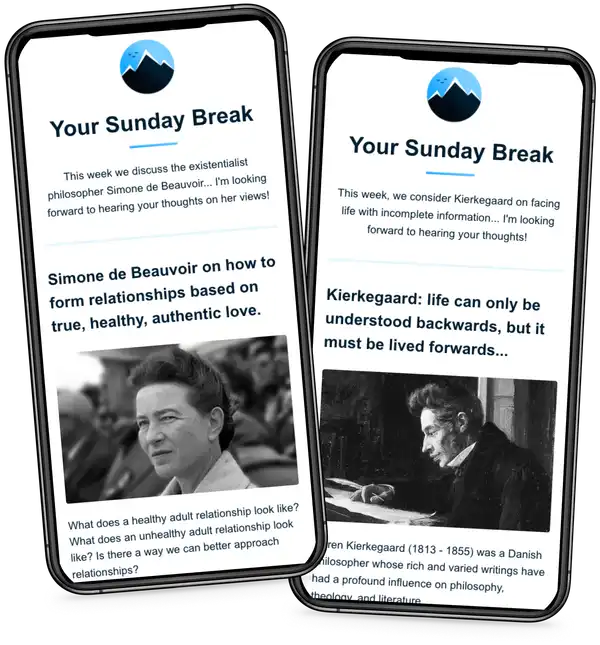
From the Buddha to Nietzsche: join 26,000+ subscribers enjoying my free Sunday Breakdown
In one concise email each Sunday, I break down a famous idea from philosophy. You get the distillation straight to your inbox.
💭 One short philosophical email each Sunday. Unsubscribe any time.
About the Author


Jack MadenFounder
Philosophy Break
👋 My name’s Jack, and I’m the Founder and Director of Philosophy Break. I’m currently writing a book, The Philosophy Prescription, which is due for publication by Torva (Penguin Random House) in Autumn 2026. Learn more about me and Philosophy Break here.
If you enjoy learning about humanity’s greatest thinkers, you might like my free Sunday email. I break down one mind-opening idea from philosophy, and invite you to share your view.
Subscribe for free here, and join 26,000+ philosophers enjoying a nugget of profundity each week (free forever, no spam, unsubscribe any time).
Get one mind-opening philosophical idea distilled to your inbox every Sunday (free)


From the Buddha to Nietzsche: join 26,000+ subscribers enjoying a nugget of profundity from the great philosophers every Sunday:
★★★★★ (100+ reviews for Philosophy Break). Unsubscribe any time.
Take Another Break
Each break takes only a few minutes to read, and is crafted to expand your mind and spark your philosophical curiosity.


